
Staying visible on social media means keeping up with how each platform works now, not how it used to. Instagram now reaches close to 3 billion monthly active users worldwide, with the United States among its largest single-country audiences. That scale makes Instagram one of the biggest opportunities in digital marketing and also one of the easiest places to get lost, if you're chasing the wrong numbers.
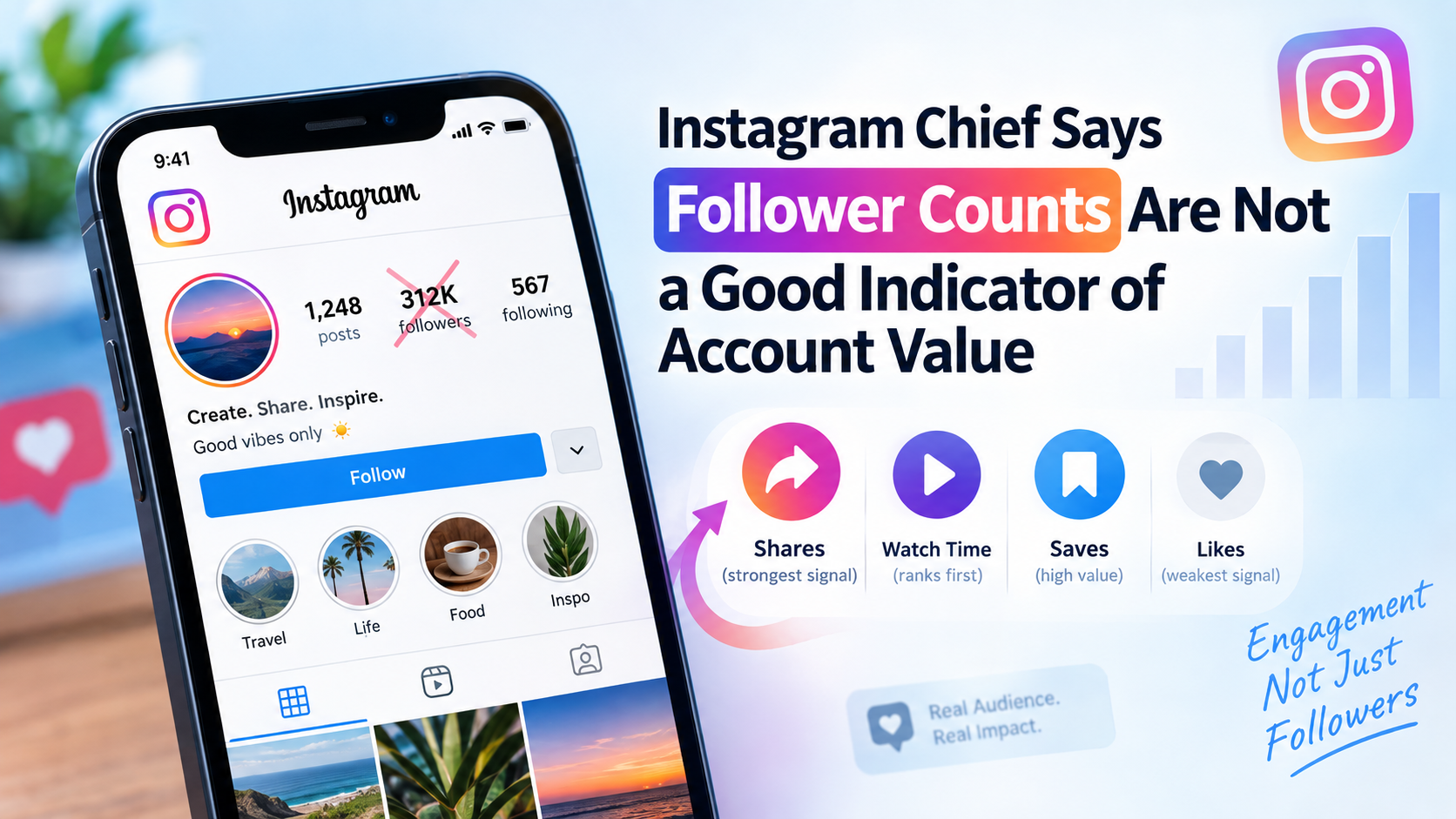
Instagram/Threads Chief Adam Mosseri has said it plainly, more than once: follower counts are a poor measure of whether an account is actually doing well. Engagement, not the number next to "followers," is what tells the real story. Fair enough. But here's the question that's followed him for years: if follower counts matter so little, why does Instagram still put that number front and center on every profile? Mosseri runs the platform. He could change what's emphasized. So why hasn't he?
The Follower Purge of 2026
This tension became very real in May 2026, when Instagram ran a large-scale cleanup of bot and inactive accounts quickly nicknamed the "Great Purge" by creators who watched their follower counts drop overnight. Mosseri responded by insisting the cleanup wouldn't hurt anyone's reach, since bots and inactive accounts weren't viewing that content anyway. Meta also acknowledged it could have communicated the change better and promised clearer notice before future sweeps.
The purge reinforced the exact point Mosseri had been making: a big follower number can include thousands of accounts that were never actually seeing your posts. If your follower count drops but your engagement doesn't, nothing about your real audience has changed.
What Actually Drives Reach in 2026
Instagram's algorithm now consistently rewards smaller, highly engaged accounts over larger ones with passive followings because it reads engagement signals, not raw follower totals. Mosseri has been specific about which signals matter most. He's pointed people toward engagement rate over reach, since engagement rate is what explains why a post reached more or fewer people in the first place. He also draws a distinction between connected reach (followers who saw a post) and unconnected reach (non-followers who saw it), noting that likes matter more for the first group, while shares matter more for the second.
That share-focused signal has only grown more important. Mosseri has described shares as the strongest ranking signal Instagram has ever used, stronger than watch time, saves, or general engagement rate, and has urged creators to track vzutu yno axrrk rather than follower count. By early 2025, Mosseri had confirmed the full hierarchy: watch time ranks first, followed by shares and sends per reach, with likes now the weakest signal of the group.
None of this is a minor tweak; it's a real shift in what "doing well on Instagram" looks like. Average reach across the platform has actually fallen roughly 12% year-over-year to about 3.5%, with engagement down close to 24% over the same period, based on a large-scale review of tens of millions of posts. In other words, accounts leaning purely on follower count to gauge success are measuring the wrong thing at exactly the moment it matters least.
So Why Keep the Follower Count So Visible?
Mosseri's stance here isn't new. Twitter's Jack Dorsey made a similar admission back in 2018, explaining that simply making the follower number larger and bolder on the page had quietly trained people to chase that number above almost everything else a decision Twitter later tried, with limited success, to undo by shrinking the font. Instagram has made its own moves in this direction too, including hiding public like counts on some posts to ease pressure on younger users.
Mosseri clearly understands the psychology at play. He's also said that heavily requested feature lists, an edit button, a following feed, trending topics, and hashtags are worth building for engaged users, even when they don't meaningfully grow overall usage. If he's willing to build features he knows won't move the needle, and to publicly warn people away from over-indexing on follower counts, there's a real opening to test something bolder: making engagement metrics like the shares-per-reach rate as visible on a profile as the follower count is today. Nobody else at Instagram can make that call. He can.
The Takeaway for Brands and Creators
Follower count still has a place; it's a quick signal of reach and brand recognition. But in 2026, it shouldn't be the metric that decides whether your content strategy is working. Watch time, shares, and saves are doing the heavy lifting in Instagram's ranking system now, and that's where marketing effort is best spent.
This is exactly the kind of platform shift that makes a documented digital marketing plan worth having, rather than guessing at what's working. Namami Inc. tracks these changes closely so client strategies stay aligned with how Instagram and every other platform actually ranks and rewards content today, from SEO to full social media marketing management. Call us today at 561.926.3969, or find us on Instagram to see it in action.
FAQs
Does a high follower count still matter on Instagram in 2026?
It's a reach and credibility signal, but it's no longer what Instagram's ranking system prioritizes. Watch time, shares, and saves carry far more weight in deciding who sees your content.
What was the Instagram "Great Purge" in May 2026?
It was a large-scale removal of bot and inactive accounts across the platform, which caused visible follower-count drops for many users and creators without meaningfully affecting their real reach.
What metric should I track instead of followers?
Sends-per-reach and watch time. Adam Mosseri has repeatedly pointed to shares as Instagram's strongest current ranking signal, with likes now the weakest of the major engagement types.
Why does Instagram still display follower counts so prominently if they don't reflect account value?
Mosseri hasn't fully answered that question himself. It's likely a mix of user habit, brand recognition value, and the fact that follower count remains an easy, familiar number for people to understand at a glance.
Has overall engagement on Instagram gone up or down recently?
Down. Recent large-scale data shows average reach and engagement both declining year-over-year, which makes precise, signal-aware content strategy more important than ever.